Anna Thorwald
Rear WindowAnna Thorwald is an absent but pivotal figure whose apparent departure becomes the central deception in the account of Lars Thorwald. A postcard attributed to her says she has arrived at a country farm and is feeling better, but the narrator’s later reconstruction treats that message as part of a plan to conceal her death, not reliable proof that she is alive. The account also separates Anna from an unidentified woman who presented herself as Mrs. Thorwald and helped handle the trunk.
Identity and the Postcard
Anna is identified as Lars Thorwald’s wife and as a person whose health had been poor for years, according to the narrator’s conjectural explanation. Her own words reach the other characters only through a copied postcard, said to have been written from a farm up-country the previous day. The message reports her arrival and slight improvement, lending the appearance of an ordinary, temporary absence.
That appearance is weakened by uncertainty about the postcard’s date. The postmark is blurred because a wet corner smudged the ink, so the investigators cannot independently establish when it was sent. The narrator presses this point rather than accepting the message at face value: the card’s apparent immediacy depends on a date that cannot be verified.
The Trunk and the Impersonation
The trunk provides a second, more consequential link between the supposed journey and the alleged deception. Investigators trace it through an express agency and contact farmhouses in the area. A woman described as Mrs. Thorwald comes to the junction in a produce truck and opens the trunk herself with her own keys. The episode establishes that someone was acting under Anna’s name or identity, but it does not establish that this woman was Anna.
In the narrator’s later account, the woman is an accomplice sent upstate near a place associated with Anna’s earlier summers, but to a different farmhouse where she would not be recognized. The trunk and its keys help make the supposed departure seem credible. This remains part of the narrator’s proposed explanation, rather than a separately confirmed account of the woman’s identity or role.
The Narrator’s Reconstruction
The narrator proposes that Anna’s long illness and Lars Thorwald’s unemployment formed part of the circumstances behind the crime. He speculates that Thorwald may have tried to poison her gradually, that she discovered what was happening, and that he then killed her in a sudden act of violence. The proposed motive and sequence are explicitly presented as conjecture, not as facts established by the postcard or the investigation described here.
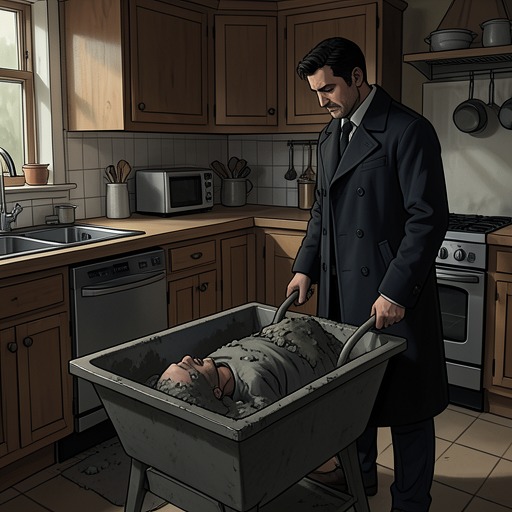
In the same reconstruction, Thorwald hides Anna’s body in a trough beneath fresh cement in an upstairs apartment, then arranges the trunk’s journey and a misleading postcard to support the story that she has left. The narrator imagines that the plan could eventually have made Anna’s disappearance appear to be a suicide. His account gives the postcard its dark significance: a message that seems to confirm a living woman’s whereabouts may instead be a prop in an effort to erase her death. The body’s concealment and the details of the alleged plot are, at this point, the narrator’s theory.
Narrative Significance
Anna’s presence in the account is mediated rather than direct. She is represented by a brief message, by questions about the card’s postmark, and by the contrast between the wife named in the story of departure and the woman who physically opens the trunk. The uncertainty surrounding those traces makes the difference between evidence and interpretation central to the mystery.
The postcard’s reassuring report and the narrator’s grim reconstruction pull in opposite directions. Because the date cannot be verified and the woman at the junction may be an impostor, the apparent proof of Anna’s departure becomes evidence of how that departure could have been staged. Anna’s absence is therefore not a blank in the investigation: it is the problem the competing accounts must explain.